When it comes to flooring installation cost Centennial, a few key things make all the difference. Flooring installation cost is one of the first questions homeowners ask, and one of the hardest to answer honestly without knowing the specifics of the project. Material type, square footage, subfloor condition, and whether old flooring needs to come out first all affect the final number.
If you’re searching for affordable flooring in Centennial, CO, understanding what actually drives the cost is the most useful place to start. At Floor and More, flooring installation projects across Centennial, Aurora, Parker, Highlands Ranch, and the broader Denver south metro have given us a clear picture of what things actually cost. Here’s the real breakdown.
What Factors Affect Flooring Installation Cost?
No two projects cost the same, and these are the variables that move the number the most.
Material type and quality are the biggest factors, since hardwood costs more per square foot than LVP, which in turn costs more than carpet. Square footage matters because larger areas spread fixed labor costs across more square footage, thereby lowering the per-square-foot rate. Subfloor condition is another significant variable since a flat, clean subfloor adds no cost, while one that needs leveling, patching, or repair adds both labor and materials.
Removal of existing flooring, transitions, and trim at doorways and room boundaries, and specialty installations like stairs, herringbone patterns, or rooms with a high number of cuts, all add to the total as well. When you call for a free estimate, all of these get reviewed before a number is quoted. Nothing gets added after the project starts that wasn’t covered up front.
What Does Hardwood Floor Installation Cost in Centennial?
Hardwood is the premium end of the flooring cost range. Material alone costs more than synthetic options, and installation is more labor-intensive, particularly for nail-down solid hardwood installations.
Solid versus engineered hardwood is the first decision, since solid material costs more per square foot, but engineered can require more subfloor prep in certain applications. Species and grade move the number significantly as well, since oak is the most common and most affordable hardwood species, while exotic species cost considerably more. Site-finished hardwood is sanded and finished on location, which adds labor but produces a tighter, more consistent look than prefinished.
Engineered hardwood is often a practical middle ground for Colorado homes. It handles the state’s dry climate better than solid hardwood and can be installed over concrete subfloors where solid wood cannot. Free estimates are available on all hardwood floor installation projects. Call (303) 993-6479 to schedule.
What Does LVP Installation Cost in Centennial?
Luxury vinyl plank is typically the most cost-effective full-room flooring option for homeowners who want a hardwood look without the hardwood price. The material is less expensive than hardwood, and the floating installation method is faster than nail-down or glue-down approaches.
Wear layer thickness is one of the main cost variables since a 12-mil wear layer is standard residential, while 20-mil and above is commercial-grade and priced accordingly. Plank width and length can also affect the per-square-foot price, and product quality varies widely at the same price point.
LVP is waterproof, scratch-resistant, and works in rooms where hardwood cannot go, including kitchens, bathrooms, basements, and laundry rooms. For homeowners replacing flooring across multiple room types, LVP often delivers the most consistent result at the best overall cost.
What Does Carpet Installation Cost in Centennial?
Carpet installation costs break down into two parts: the carpet itself and the padding underneath. Padding quality affects how the carpet feels and how long it lasts, and skimping on padding to save money typically shortens the carpet’s useful life.
Fiber type is the main driver: nylon is the most durable and most expensive; polyester is softer but less resilient; and olefin works for low-traffic areas. Pile height and density affect both feel and price, and a medium-density pad in the 6-8 lb range balances comfort and lifespan well.
Most carpet installations are completed in one day for a single room, and whole-home carpet replacement may take two days. Removal of the old carpet is included in the installation scope. Carpet installation estimates are free. Call (303) 993-6479 or reach out online.
What Does Tile Floor Installation Cost in Centennial?
Tile is the most labor-intensive flooring to install, and the cost reflects that. A proper tile installation requires a level subfloor, the right mortar bed, careful layout planning, and grout applied and sealed correctly. Done right, tile lasts indefinitely.
Large-format tiles require more precise cutting and a flatter subfloor, both of which add to labor costs. Material type also significantly affects price, since ceramic is the most affordable, porcelain is denser and more durable, and natural stone is the premium tier. Diagonal, herringbone, or custom patterns add labor time compared to straight-lay layouts, and epoxy grout costs more than sanded grout but is considerably more stain-resistant in kitchens and bathrooms.
Ceramic, porcelain, and natural stone tile installations are available for floors, walls, and showers. Tile floor installation estimates are free.
Does Subfloor Preparation Add to the Cost?
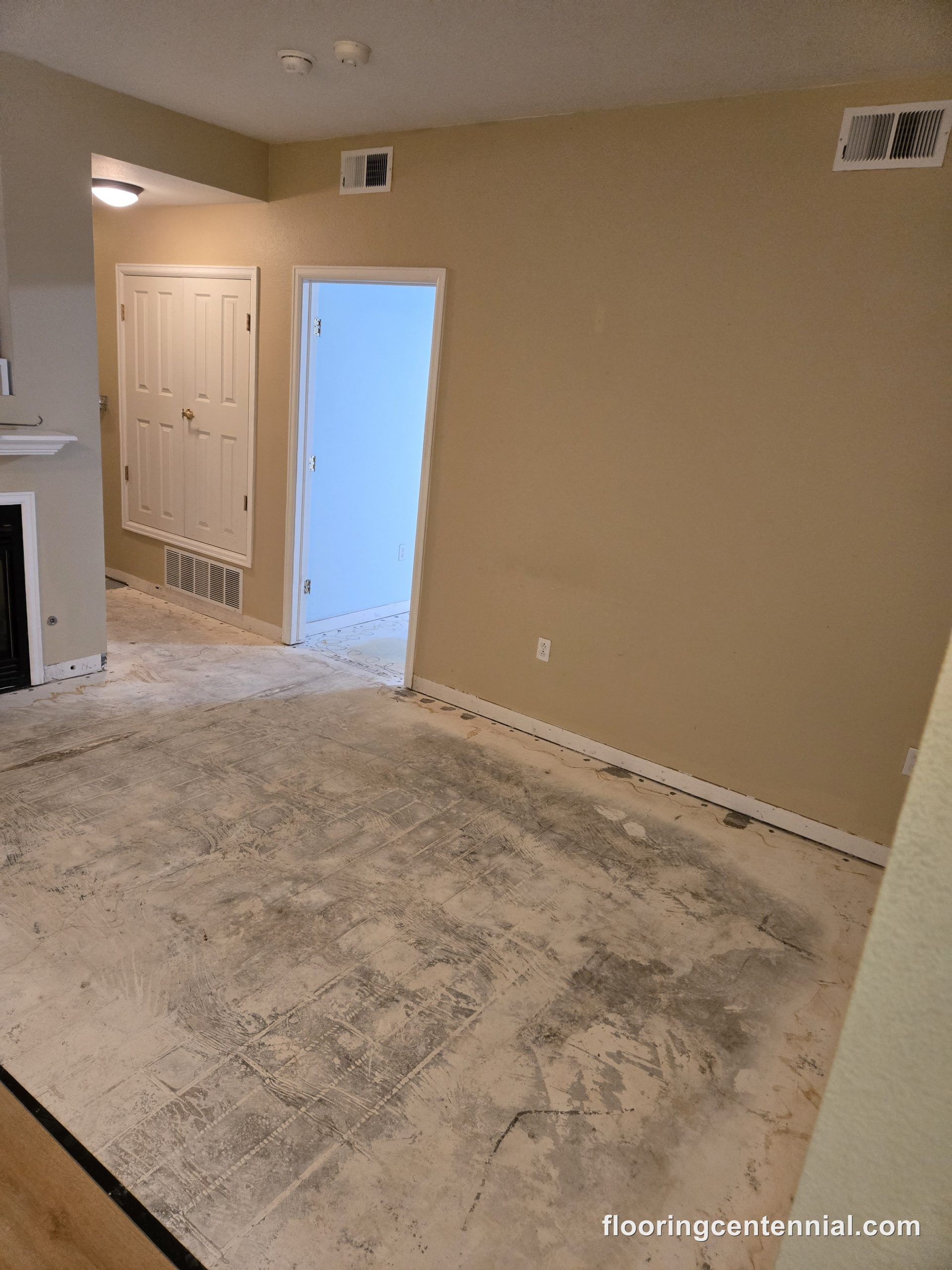
Yes, and it’s worth understanding why before the project starts. The subfloor gets inspected on every installation. If it’s flat, clean, and structurally sound, there’s no added cost. If it needs leveling, patching, or repair, that work gets priced into the estimate before anything begins.
Skipping subfloor prep to save money is the most common reason flooring fails early. Squeaking, cracking, uneven wear, and lifting edges all trace back to a subfloor that wasn’t properly addressed. That work won’t be skipped, and exactly what’s needed will be communicated before you commit to the project.
Is It Worth Replacing Flooring Before Selling a Home?
In most cases, yes. Updated flooring, particularly replacing worn carpet with LVP or hardwood, consistently ranks among the highest-return pre-sale improvements. It affects buyer perception, listing photography, and the offers that come in.
Many homeowners prepping a property for listing are working on a tight timeline. The goal is fast turnaround, clear pricing, and a finished floor that photographs well. A specific timeline is provided before every project starts, so there are no surprises on the day of the listing date. And if the project involves more than flooring — outdated cabinets or a kitchen that needs a refresh — Floor & More handles cabinetry and full interior remodeling too, so you’re not coordinating multiple contractors before a sale.
Related topics:
For additional guidance, see the National Association of the Remodeling Industry.
Not sure if we cover your neighborhood? Check out areas we serve.